


A field experience near Natchitoches gave students a closer look at forestry, land management and wildlife conservation in Louisiana.
Forest lessons take root for Northwestern State students

NATCHITOCHES, LA — The lesson began away from a classroom, where the road narrowed, the trees thickened and a group of Northwestern State University students stepped into the kind of outdoor laboratory that cannot be duplicated on a screen.
On a privately held tract of land near Natchitoches, students joined forestry professionals and conservation experts for a field experience focused on forestry, land management and wildlife habitat. The visit brought together representatives from the American Bird Conservancy, Echo Forestry, Walsh Timber and RoyOMartin, giving students a close look at how managed forests support healthy ecosystems, economic value and wildlife conservation in Louisiana.
The students in attendance, Nilah Pollard of Shreveport, Madysen Morgan of Bossier City, Katharyn Evans of Benton, Owen Stutzman of Gonzales, Vivian Montalvo of Forest Hill, Madelynn Misuraca of Natchitoches and Anastasia Douglas of Shreveport, came to the woods to learn. They left with a clearer understanding that forest management is a working science, shaped by biology, business, landowner goals, water quality, soil protection and the needs of wildlife that depend on changing habitat.
For Northwestern State, the trip reflected something the university works to build across disciplines, practical learning that puts students beside professionals and gives classroom ideas a place to land. In this case, the classroom had pine, hardwood and mixed forest stands. It had thinned areas, stream buffers and sections shaped by management decisions. It had birds overhead and, in the understory, some seen, some heard, all helping tell a larger story about the connection between people, land and conservation.
Emily Jo “EJ” Williams, vice president for North American Birds and Habitats and vice president for the Southeast and Atlantic Coast Region for the American Bird Conservancy, helped lead the experience. A retired wildlife biologist with a long career in conservation, Williams has spent decades focused on migratory birds and the forests they rely on across the Southeast.
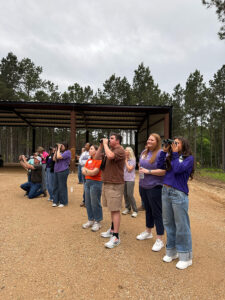
Field Experiences
“Every management decision that foresters make, or loggers make, results in some type of habitat response,” Williams said. “Different birds respond to different habitat outcomes.”
That idea sat at the center of the day. Forests are not all supposed to look the same. A thinned pine stand may open the canopy and allow understory plants to grow, creating food and cover for wildlife. A prescribed burn, carefully planned and carried out by trained professionals, can restore a natural process that supports forest health and creates conditions certain birds need. A shrubbier section of forest may support species that avoid open areas. Together, those differences create habitat diversity, and habitat diversity supports bird diversity.
Jesse Foshee of Provencal, a student majoring in communications with a concentration in broadcasting journalism and digital media production, said the experience changed how she understood forestry and conservation.
“Before this experience, I assumed cutting trees down mainly harmed wildlife habitats,” Foshee said. “However, I learned that when logging is done responsibly and strategically, it can actually improve forest health and create environments that support birds during migration, nesting and raising their young.”
Foshee said the trip also showed her the value of learning outside the classroom, especially through opportunities connected to the NSU Foundation and its supporters.
“As a Gallaspy Scholarship recipient during my time at NSU, this experience was especially eye-opening because it showed me another side of how the NSU Foundation connects students with educational opportunities,” Foshee said. “It was rewarding to see how support from industry partners and private sites can directly impact students through hands-on learning experiences outside the classroom.”
Enyart Mitchell of Echo Forestry said the tour helped students see how forestry decisions shape the land over time.
“We looked at the general aspects of how the forest comes together and what it takes to make something look a certain way,” Mitchell said. “When you have a healthy bird and wildlife population, generally you have a healthy forest.”
Mitchell said land management has to account for more than timber value alone.
“Our goal in management is, of course, to manage for monetary concerns,” Mitchell said. “But we also take into consideration what you want from the property and what it can give back in emotional value, recreational value and sustainability for the future.”
Joe Cooper, a forester with Echo Forestry, said the visit gave students a practical look at the science and planning behind responsible forest management.
“We tried to show the students the value of proper forest management and how it benefits not only wildlife, but the landowner economically,” Cooper said. “We talked about how we inventory timber, determine harvest planning and use statistics and sampling to determine timber volume.”
Cooper said healthy forests depend on careful decisions that protect the land while keeping it productive.
“We talked about management techniques to protect soil quality, water quality and wildlife,” Cooper said. “Proper forest management really makes all that come together.”
That blend of science and application matters for Northwestern State students. Prospective students often ask what they can do with a degree. Experiences like this answer in a direct way. They show how communication, science, conservation, agriculture, business, technology and public service intersect in real places, with real professionals, on land that carries both economic and environmental importance.
Louisiana’s forests are part of the state’s identity and economy, but they are also part of a larger conservation story. Many birds that use these forests spend much of their lives south of the United States, then return to places like Louisiana during breeding season. Williams said these forests are critical, especially in a region where land use continues to change and forest value can influence whether land remains forest at all.
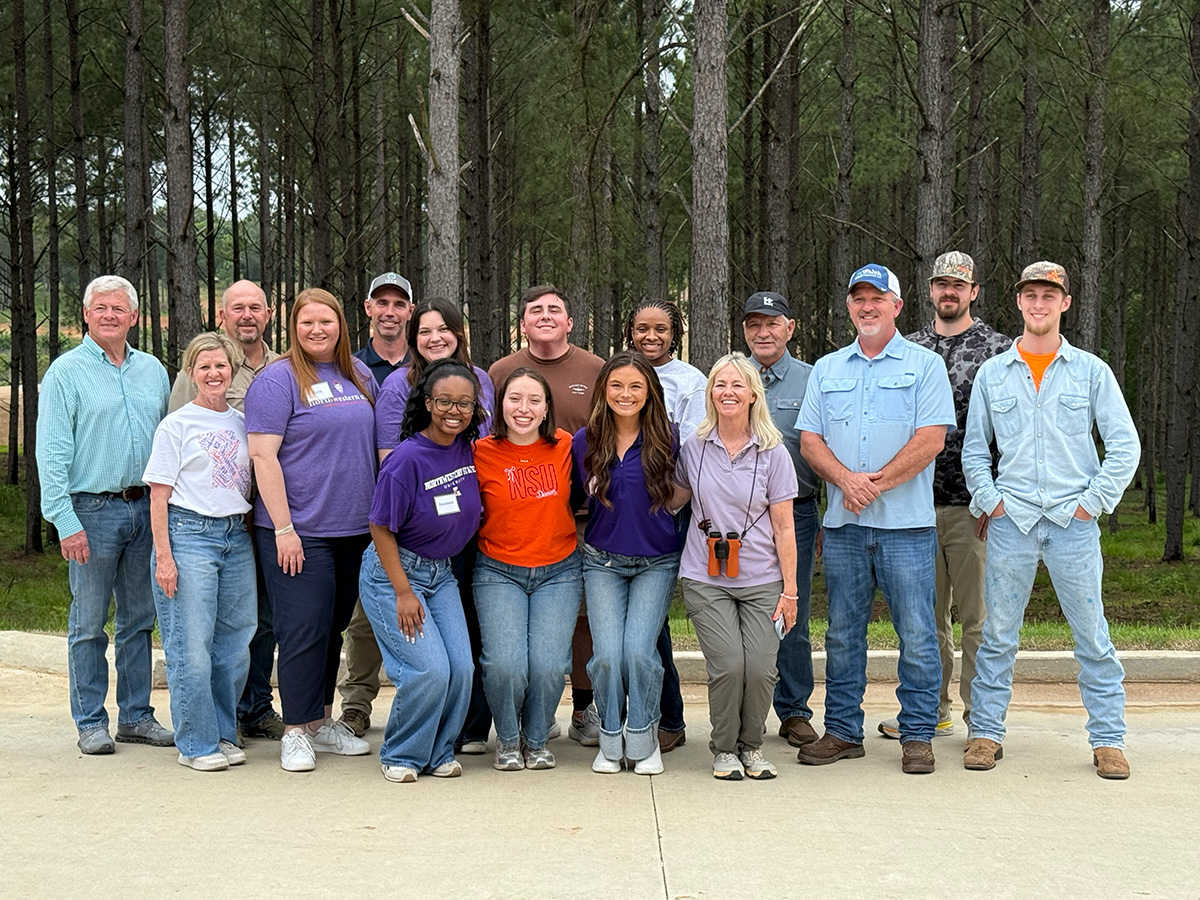
A field experience near Natchitoches gave students a closer look at forestry, land management and wildlife conservation in Louisiana. On the front row from left are Anastasia Douglas, Vivian Montalvo, Jesse Foshee and Emily Jo Williams. On the second row are e Michael Simpson, Reatha Cox, Jolly Nash, Kate Evans, Clint Iles, Madysen Morgan, Owen Stutzman, Nilah Pollard, Enyart Mitchell, Joe Cooper, Waylon Herring and Steele Colclasure.