



Become an organ donor here: https://northwesternstatealumni.com/organ-restoration/
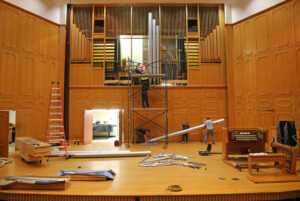
Organ Master and President of Reuter Organ Company JR Neutel, top of scaffold, worked with four assistants to manually remove the largest pipe, which weighs about 300 pounds, from NSU’s famed pipe organ. The instrument’s components are now on their way to Lawrence, Kansas, where they will be cleaned and upgraded, to be reinstalled at NSU later this summer. Giving opportunities to support the organ renovation are available at https://northwesternstatealumni.com/organ-restoration/.
NATCHITOCHES – Specialists from Reuter Organ Company arrived in Natchitoches this week to disassemble, pack and transport Northwestern State University’s famed pipe organ back to its place of origin in Lawrence, Kansas, where it will undergo cleaning, repairs and expansion with the addition of digital components. The organ is expected to be reinstalled in late summer with a fall concert in the works for a rededication.
For Albert “JR” Neutel Jr., it was like greeting an old friend.
Neutel, now president of Reuter, installed the organ in Magale Recital Hall in 1983, a process that took about six weeks, and was pleased to be back in Natchitoches. He said that with the 43-year-old organ’s operating system beginning to fail, it’s time it got some care and attention.
“It will get a basic cleaning. There are some reed pipes that have a vibrating brass tongue that are going to be cleaned because it affects the speech of those,” Neutel said. The organ also developed a cipher, a malfunction in which a pipe continues to sound after the key is released.
Neutel is a master pipe organ builder, tuner and voicer. Voicing, the skill of adjusting pipes to manipulate sound, has been called the ultimate convergence of science and art. He joined Reuter in 1980 in the footsteps of his father, Albert Neutel Sr., a Dutch-born organ master who immigrated to Canada and started his own company before joining Reuter in 1978. Reuter was founded in 1917 and has built and installed more than 2,200 instruments for churches, synagogues, concert halls and residences throughout the U.S. and abroad, each designed for its specific space with no two exactly alike.
NSU’s pipe organ is an upper-midsized instrument. Audiences who have attended performances in Magale are familiar with the organ’s largest metal and wooden pipes, a dramatic visual component of the performance space, but don’t realize the extent of the elaborate forest of pipes hidden behind the paneled walls. NSU’s organ has 42 ranks (sets of pipes of a similar type or sound quality) which equates to about 2,400 pipes. The organ’s console, which includes keyboards, pedals and stops, will also get a good cleaning and additional digital voices, doubling its versatility.
After dismantling a network of smaller wooden and metal pipes, Neutel and a crew of experts, borne by scaffolding and careful choreography, manually removed the largest pipes, which are made of zinc and weigh up to 300 pounds. Although it took just over a day to disassemble, reassembly will take about two weeks.
“We should be back by mid to late July and the goal is to be done by Labor Day,” Neutel said.
With their majestic, powerful sounds, pipe organs have a long connection to Western music and worship, often associated with the grandeur of massive cathedrals and royal coronations. Last year, the oldest pipe organ in the Christian world, built in the 11thcentury, was played for the first time in 800 years in Jerusalem’s Old City. The oldest functioning pipe organs in Europe date to the 1400s. By the 17th century, the pipe organ was the most complex human-made device, supplanted by the telephone exchange in the late 1800s. Today, traditional pipe organs can be enhanced with digital capabilities, blending centuries-old craftsmanship with 21st century technology.
NSU’s pipe organ was installed when the university created the Dear School of Creative and Performing Arts and expanded facilities to include classrooms and studios for fine and graphic art, music, choir and band, Magale and Orville Hanchey Gallery. It’s often still referred to as “the new fine arts wing.” J. Wayne Crowder was NSU’s professor of organ and music theory at the time. The organ often accompanies orchestra performances and is a special asset for music majors pursuing NSU’s concentration in sacred music, the only program of its kind in Louisiana. Dr. Mary Deville is NSU’s current director of organ studies.
“It’s hard to find an organist to play in church these days,” said Bill Brent, a former director of CAPA who arrived at NSU just a few weeks after the organ was installed in 1983. “There just aren’t many and it’s a shame because the salary is good. Students who want to pursue a degree in sacred music and especially organ performance are going to want to play this instrument.”
“Especially after all these enhancements,” Neutel added.
Renovation and repair are inevitable for pipe organs and have become incredibly expensive. NSU’s organ cost $300,000 in 1983. It’s replacement value today would be about $1.5 million. Brent is coordinating a campaign to raise $286,000 to pay for its cleaning and improvements.
Neutel is thinking about retirement and Reuter no long takes on large projects but is working with NSU’s pipe organ because of his long relationship with the university.
“If we were to try to go out and find another company, there would be no way to have this done,” said Scott Burrell, CAPA’s current director. “Because of our relationship with JR and his company, it’s perfect.”
Giving opportunities range from $1 to a naming opportunity at $125,000, which includes a commemorative plaque on the organ’s console. Donors of $1,000 to $10,000 will be recognized on a permanent plaque at the entrance to Magale. All donors will be recognized in a program printed for the gala and dedication concert when the instrument is reinstalled.
“Bill and I are already chatting about bringing in someone for the dedication and possibly fill the house, someone who can show all of the new sounds and maximize the instrument,” Burrell said.
“This is more than a much-needed renovation,” Brent said. In the coming years, they also hope to arrange a concert series in which alumni of the sacred music concentration who are working as organists around the country would return and experience what the pipe organ has become.
To donate online visit:
https://northwesternstatealumni.com/organ-restoration/
Donations can also be mailed to the Office of Alumni & Development, Natchitoches, LA 71497, with checks made payable to the NSU Foundation and Organ Fund written in the memo.
For additional information, please contact Brent at brent@nsula.edu or (318) 357-4248.
Information on NSU’s music degree and concentration in sacred music can be found at
https://www.nsula.edu/program/bachelor-of-music/.
Information on the Reuter Organ Company is available at https://www.reuterorgan.com.