

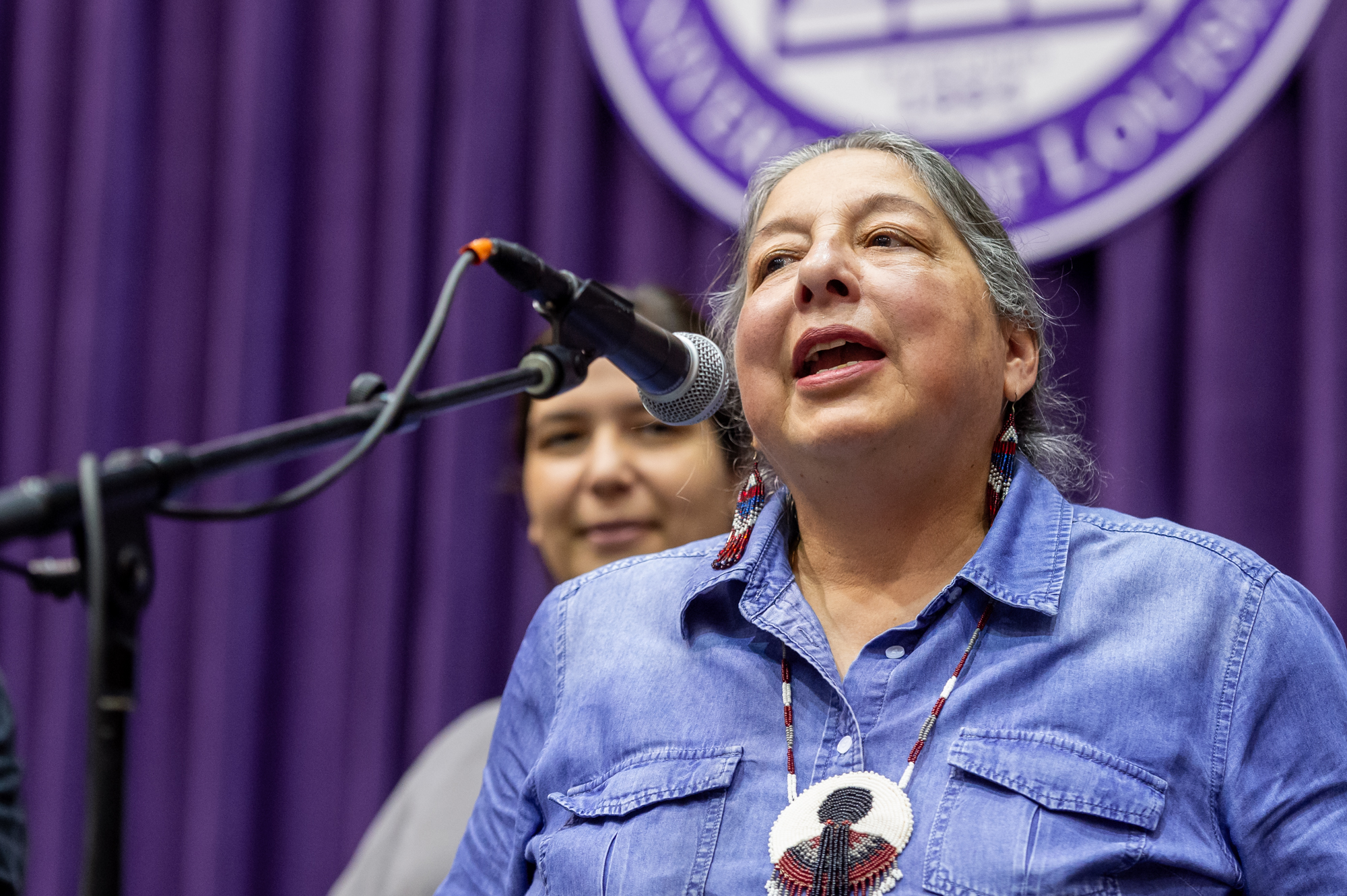
Alumna Rhonda Gauthier will also be honored with the second NSU Indigenous Studies Alumni Award at the free public screening.
NATCHITOCHES – About 50 miles from Natchitoches is the center of the Choctaw-Apache Tribe of Ebarb, an Indigenous community which, over the centuries, created a unique culture as it coalesced at the Spanish mission at Los Adaes and welcomed Indigenous refugees from several tribes, incorporating ancestral cultures and Spanish influences into one distinct community centered in what is now Sabine Parish since the 1700s.
A distinct feature of the Choctaw-Apache Tribe is its unique foodways, including its distinctive variety of tamales. Documentary filmmaker, public historian and culture keeper Rhonda Gauthier grew up making Choctaw-Apache tamales with her elders and has shared the complex process of turning corn ears into masa, then forming the tamales, with new generations, just as she works to keep other Choctaw-Apache traditions alive. Her documentary, From Maize to Masa, celebrates the culture and traditions of tamale-making.
Gauthier, a Northwestern State University graduate, will show From Maize to Masa and speak at NSU at 5 p.m. Monday, Nov. 2 in the Student Union Cane River Room. The event is free and open to the public, and refreshments will be served. The event is sponsored by American Indian and Indigenous Studies Minor, one of two Ethnic Studies programs at NSU and part of the School of Social Sciences and Applied Programs, and the Gail Metoyer Jones Center.
“We appreciate that Ms. Gauthier is going to share her film and knowledge with the NSU student and faculty community,” said Brittany Blackwell Broussard, Psychology instructor and director of Campus-Community Relations and the Jones Center.
Gauthier earned Bachelor of Arts degrees in Anthropology and History at NSU. She is a long-time historical interpreter and past president of the Ho Minti Society, a nonprofit that supports Choctaw-Apache cultural traditions. She is a skilled artist who uses traditional mediums such as beadwork, basketmaking and regalia making, and a popular demonstrator at historical and cultural events.
“This talk will interest filmmakers, food scholars, tribal members, students and those who want to know more about communities around NSU. Everyone is welcome to join us,” said Dr. Charles Pellegrin, history professor and interim director of the School of Social Sciences and Applied Programs. Pellegrin noted that NSU has long partnered with American Indian nations in Louisiana, from providing research support, to serving students. Today, it offers a tuition waiver to American Indian students who are members of federally recognized Native nations.
Gauthier will also be honored as the Second American Indian and Indigenous Studies Alumnus Award recipient in recognition of her significant contributions to the field of Indigenous Studies. She will be gifted a blanket from her programs in a traditional ceremony.
“The blanket ceremony is a traditional way to recognize someone who has done something really good for their community,” said Dr. Heather Salter Dromm (Choctaw-Apache), instructor of English, Languages and Cultural Studies “Rhonda Gauthier has spent her entire career and countless volunteer hours teaching traditions to young people and educating the public about her tribe. We look forward to honoring her.”
“NSU is unique in having one of only two American Indian and Indigenous Studies programs in the state, and the only one to focus on North America,” said Rebecca Riall (Cherokee Tribe of Northeast Alabama), American Indian and Indigenous Studies Coordinator, who teaches anthropology and pre-law. “For a small school, our alumni have left a large footprint on Indigenous Studies in the region.”
For more information, contact Riall, riallr@nsula.edu.