
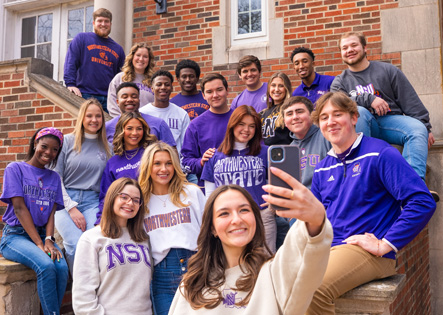
NATCHITOCHES – Northwestern State University’s AI Club welcomed students for the first time this fall, hosting eight seminars from Oct. 16 to Nov. 18 in which NSU faculty shared how they use, teach and study artificial intelligence.
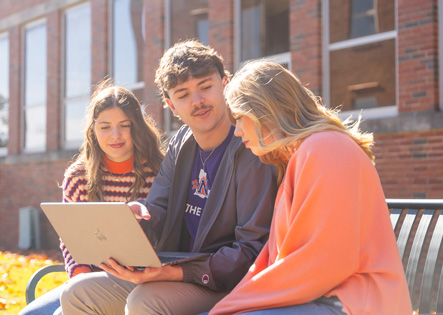
The Fall 2026 Speaker Series met Wednesday afternoons and Friday mornings in Fournet Hall, with every session also streamed on Microsoft Teams. Several seminars paired a presentation with hands-on activities. All were open to faculty, staff and students from each of NSU’s four colleges, the College of Arts and Sciences, the College of Business and Technology, the Gallaspy Family College of Education and Human Development and the College of Nursing and Allied Health.
The NSU AI Club was founded in 2024 by Dr. Nabin Sapkota, professor in the Department of Engineering and Technology, and Dr. Damien Tristant, coordinator of the Department of Physics. It began as a way for faculty and staff to learn what AI is, from large language models to machine learning, through short talks and practical exercises. Opening the series to students this semester brought the whole campus into the conversation.
Dr. Anthony Pursell, director of Bands, opened the series with a framework for designing AI-generated performance feedback that helps performers improve rather than leaving them with one more summary to sort through.
Dr. MaryAnne Candley, head of the Department of Social Work, followed with “Beyond the Ban,” describing how she integrates AI into an upper-level Bachelor of Social Work course while protecting critical thinking, ethical judgment and human responsibility.
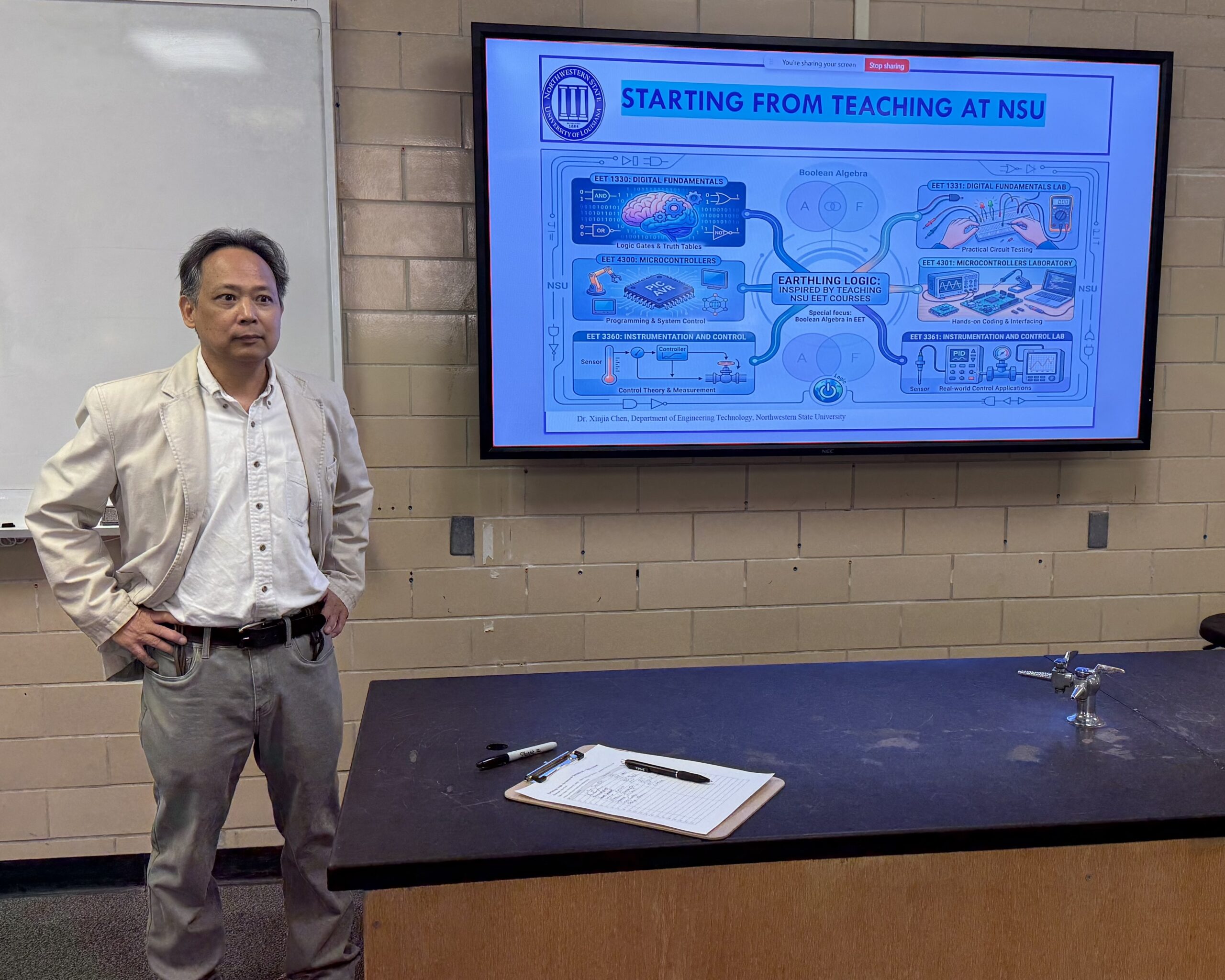
Dr. Xijia Chen, professor in Engineering Technology, introduced Earthling Logic, a framework for reasoning about partial truth that could serve as a foundation for more transparent and trustworthy neural-symbolic AI.
Tristant asked, “Can a Computer See a Brain Tumor?” He walked participants through a deep learning model that classifies brain MRI scans with about 92 percent accuracy, then had them run the model themselves.
Tamara Roe, assistant professor of nursing, demonstrated practical uses of generative AI for course design, assessment and scholarship, with faculty expertise and academic integrity kept firmly in charge.
Craig Caskey, instructor and lab coordinator for Engineering Technology, shared results from his ongoing experiment using AI to redesign slides, generate assignments and catch accessibility problems, including the moments the AI got it wrong.
Dr. Robert Page, professor of biology, showed how large language models can help scientists with little coding experience create publication-quality figures in R and the tidyverse.
Dr. Daniel Rivera, associate professor of chemistry, closed the series with a look at AI in chemistry education and research, stressing a human-in-the-loop approach and careful verification of AI output.
Across disciplines, the speakers returned to a common message: AI is most useful when knowledgeable people remain in charge.
Missed a session or want to watch one again? Recordings and presentation materials are available at: AI Club – Speaker Series Fall 2026.
The AI Club will issue a call for presenters for its Spring 2027 series. Faculty, staff and students who have used AI in their teaching, research or work are encouraged to take part; no expertise is required.
For more information, contact Sapkota at sapkotan@nsula.edu or Tristant at tristantd@nsula.edu.