


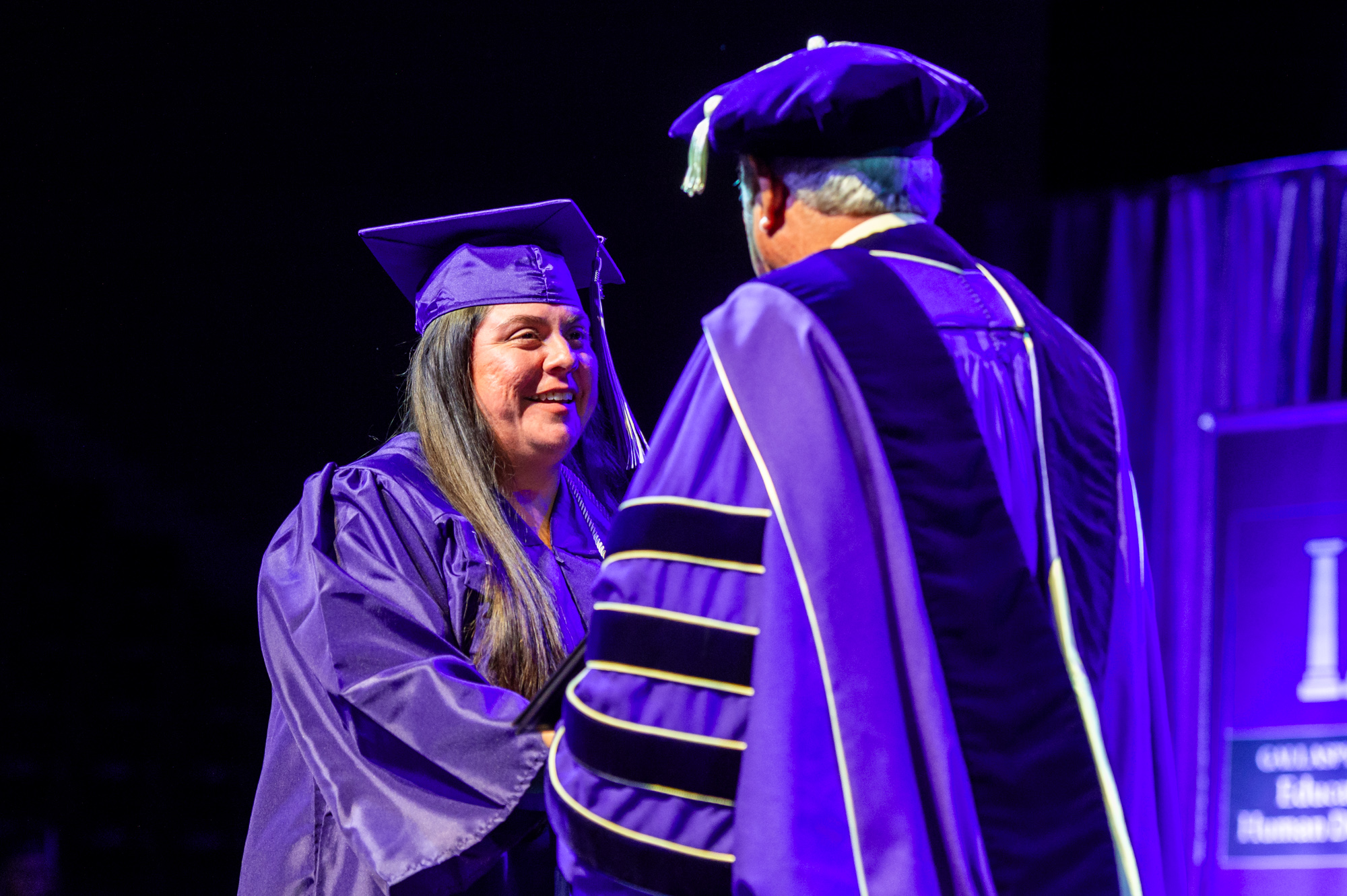

NATCHITOCHES – Elisabeth Pierite of Marksville earned a degree in liberal arts with a minor in anthropology at Northwestern State University this week, completing a long journey that honors her family and devotion to her community. A member the Tunica-Biloxi Tribe of Louisiana, Pierite plans to use her degree to continue to advance cultural awareness, preservation and tribal initiatives in which she is deeply involved.
Pierite has worked for the tribe since 2014 and is currently a cultural specialist in the Department of Culture and Education. Work with the Tunica-Biloxi Language and Culture Revitalization Program has resulted in a print and on-line native language dictionary.
Pierite’s college journey began at LSU-Alexandria in 2007. She transferred to NSU in 2008 pursuing a bachelor’s degree in heritage resources and was instrumental in organizing NSU’s American Indian Student Organization and the NSU Pow Wow.
“We organized the NSU Pow Wow for three years during 2009-2011. John Barbry was encouraging of my efforts during this time. He became my director in 2014 and has also been a supporter of my continued education,” Pierite said. Barby has been the chairman of the Tunica-Biloxi Pow Wow since it began in 1996.
NSU’s heritage resources program was eliminated due to budget cuts in 2012. Pierite married and started a family while contining to take classes periodically over the years. Last fall, while doing research work and with only a few credits needed to graduate, she reenrolled.
“Thinking back to my grandfather’s life experiences, I knew it was important for me to finish school. I wanted to do this for my grandparents on both sides of my family. Being a student of Dr. [Pete] Gregory, it was especially important for me,” she said.
Gregory is a highly respected professor, archaeologist and anthropologist at NSU, a long-time advocate for American Indian tribes and a mentor to many students over the decades.
“Having worked with my tribe, the Tunica-Biloxi, and the tribes of Louisiana for many years, Dr. Gregory knew my paternal grandparents and great grandparents well,” she said. “He has contributed greatly to the preservation of my tribe’s history and culture. My family worked with Dr. Gregory for many years while my great grandfather was chief of our tribe during the 1960s and while my grandfather was chairman of our tribe during the 1970s. My grandfather did not have access to education as we do today. He did, however, know the value of education and dedication. During his time as chairman of our tribe he advocated for American Indian education in Baton Rouge, and he saw that our tribe gained state recognition and that our tribe was headed towards federal recognition.”
Pierite is the daughter of Michael R. Pierite and Donna M. Pierite. Her paternal grandparents were Joseph Pierite Jr. and Fannie Lou Ben Pierite. Paternal great grandparents were Joseph Alcide Pierite Sr. and Rose Jackson Pierite. She has three daughters, a 13-year-old and 4-year-old twins.
“My grandmother was his inspiration. She was one of the first Choctaw people in Mississippi to complete college. My maternal grandparents were also successful. They pursued their education and careers after moving from rural Louisiana to New Orleans. They encouraged me throughout my primary and secondary schooling to study and remain dedicated to doing well.”
Pierite’s parents also focused on education throughout their careers.
“My mom completed a bachelor’s in foreign language education and a second language specialist in Spanish while she was six months pregnant with my brother,” she said. “After my brother was born, she continued her education and received a master’s in education curriculum and instruction with a minor in applied linguistics. I recall my mom and dad attending college courses while I was in elementary and middle school. I would accompany them to class. That was my first experience of college. My father was encouraged by his parents and extended family to continue his education. My father’s extended family values education greatly. They have also been my inspiration. Many are educators or are continuing their studies in their chosen careers.”
Northwestern State has a long relationship with the Tunica-Biloxi Tribe, collaborating on initiatives that advance workforce and economic development, scholarship, research and cultural resource support. In addition to a learning site in Marksville, NSU has a tuition waiver in place for federally acknowledged American Indian tribes through the American Indian Opportunity Plan.
“Like my many mentors, I want to continue my education so I may continue to serve my community. I plan to pursue a second bachelor’s degree and I am aspiring to apply for graduate school to gain experience in library sciences and archives,” Pierite said.
Information on the Tunica-Biloxi Tribe of Louisiana can be found at https://www.tunicabiloxi.org/. Information on NSU’s American Indian Opportunity Plan is available at www.nsu.la/aiop. Information on NSU’s Marksville campus is available at https://www.nsula.edu/about/campuses-directions/marksville/.