
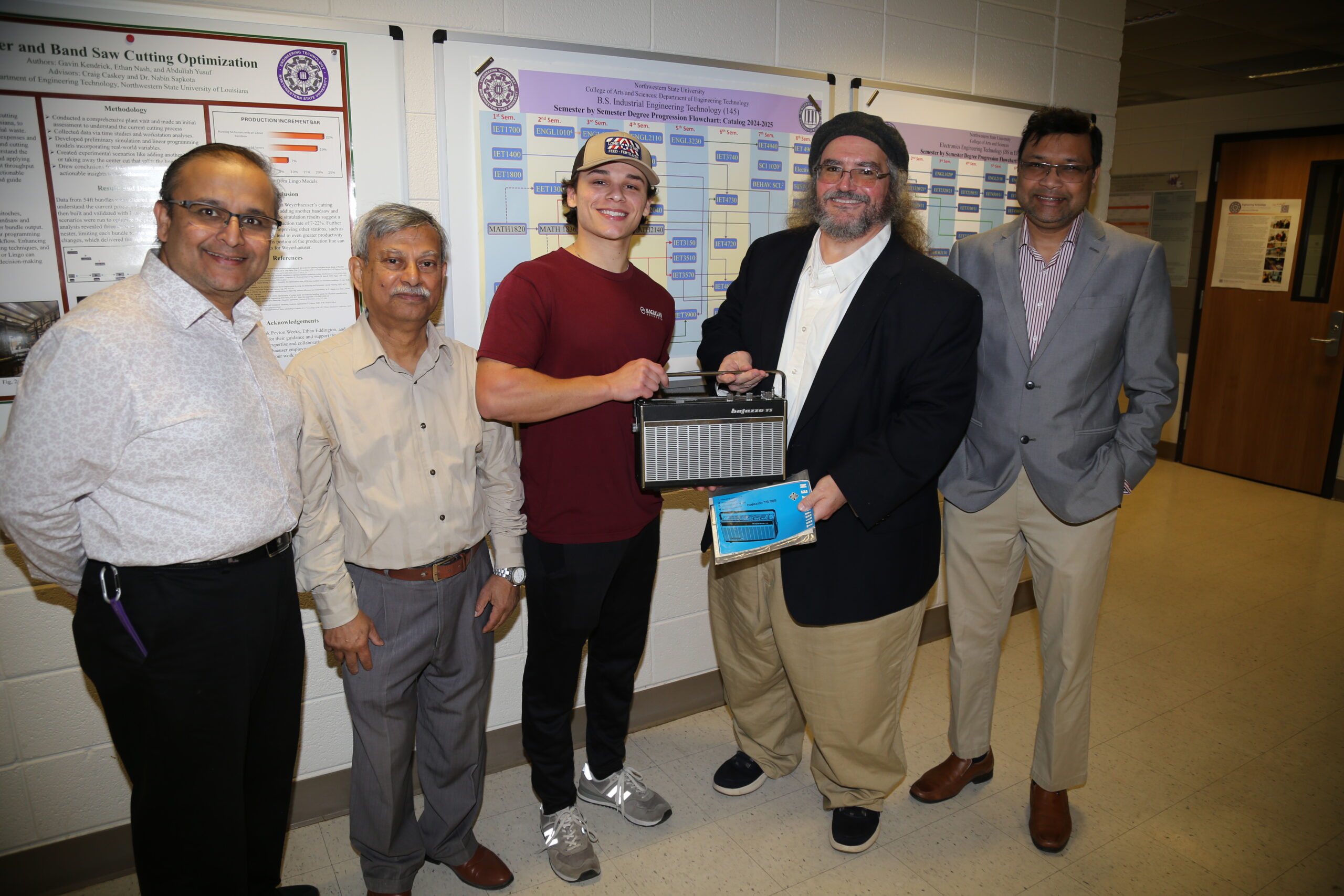

NATCHITOCHES – A 60-year-old radio in need of repair created an opportunity for a Northwestern State University student to learn about technology of the past and how it remains relevant today.
Dr. Charles Pellegrin, a professor of history at Northwestern State University, wanted to restore a radio that his father purchased when he completed his military service in November 1966. The elder Mr. Pellegrin saw an ad in an armed services magazine for a West German-made Telefunken AM/FM portable stereo with two shortwave bands.
“He bought it as a gift to himself when his service was over,” Pellegrin said. His father served in the U.S. Army and later in the Air Force Reserves. Back home he worked more than 30 years in electronics, sales and telecommunications in Lafourche Parish and taught Industrial Electronics at the vocational-technical school in Galliano.
The radio stayed at Pellegrin’s grandparents’ house for several years until he acquired it during his undergraduate days at Nicholls State in the 1980s. The accompanying manual and electronic schematics were located among his father’s possessions after his passing in August 2021. Pellegrin said an identical Telefunken model made a cameo in the 1987 film “Good Morning, Vietnam,” which was set in 1965.
“Since my father passed, I’ve been trying to crank it up, but there are no parts that can be used to fix it up,” Pellegrin said.
He reached out to NSU’s Department of Engineering Technology for help, which presented a unique opportunity for Hayden Alberes of Pierre Part who is majoring in electrical engineering technology with a concentration in biomedical engineering technology.
Alberes admitted he was intimidated at first. The radio weighs about 10 pounds and runs on five D-cell batteries, which was high-tech at the time. He spent more than two weeks researching the radio model and found a digital copy of the radio’s paperwork online. After a bit of tinkering, he discovered a problem with the shortwave choke
“It was complicated because it was old technology,” he said. “There are pulleys and capacitators for air. It was refreshing because you can see everything working.” While fixing the radio, he picked up stations in Mexico and the Carolinas.
“Shortwaves travel very long distances because they bounce off the atmosphere,” Pellegrin said. “During the Cold War, shortwave was important in that it was used for communication and propaganda. They can be useful during times of emergency but to me it has more sentimental value.”
“This was made when people made things to last, as opposed to today’s throwaway culture,” said Albares who will graduate in May 2027.
When Albares returned the repaired radio to Pellegrin, he provided a research report on the project outlining what failed and what he was able to fix. His professors in Engineering Technology were on hand to offer congratulations. Department Head Dr. Shahriar Hossain suggested Alberes prepare a presentation for NSU Research Day to share his experience.
“It’s an example of Engineering Technology and History collaborating to give a student a unique project,” Pellegrin said.
Information on NSU’s Department of Engineering Technology is available at https://www.nsula.edu/academics/colleges-and-schools/school-of-stem/engineering-technology/
Information on NSU’s History program is available at https://www.nsula.edu/program/bachelor-of-arts-in-history/.